
Fostering sustainable livelihoods
87% MSMEs Supported
87% of supported MSMEs report increased revenue, with 30% securing new business grants
4,500+ Trained
4,500+ young people and women (50% female) trained in digital skills and employment access
45% Young People Trained
45% of trained young people and women gained new or improved employment through SDN's digital skills programmes
₦180M+ Invested
₦180M+ invested in community-based livelihood initiatives across 9 Niger Delta communities
Rebuilding Agricultural Livelihood in the Niger Delta
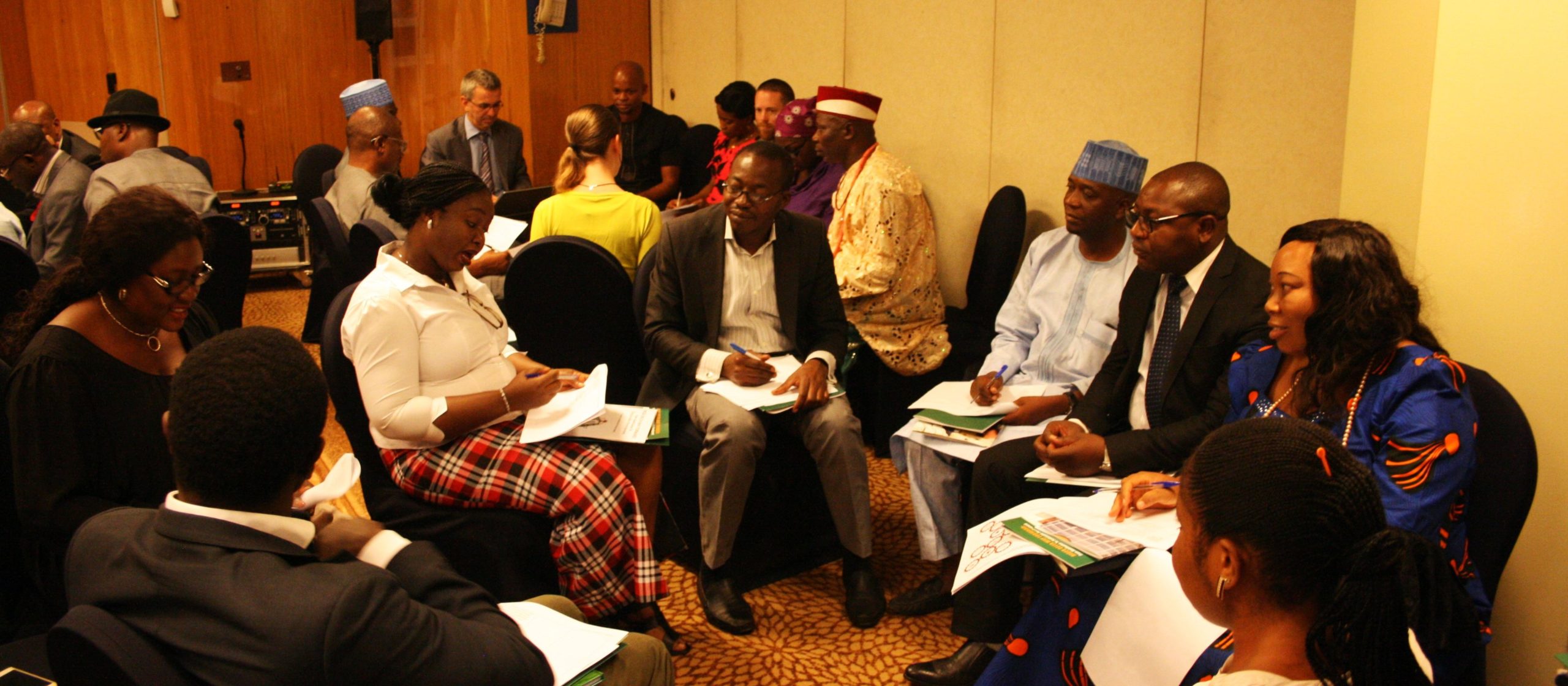
Funded by the Open Society Initiative for West Africa (OSIWA/Open Society Foundations-Africa)
Across four hard-to-reach riverine communities in Bayelsa State — Etieama, Agbakabiriyai, Ogboinbiri, and Igbomotoru — smallholder farmers were left doubly exposed: cut off from the financial and insurance services that could help them recover from COVID-19’s economic shock, and increasingly vulnerable to flooding and climate change with no access to climate-smart farming techniques. Baseline research found that 84% of farmers had no awareness of the financial and technical support already available to them.
SDN’s 15-month intervention tackled both problems directly — connecting farmers to financial institutions (Bank of Agriculture and NIRSAL), delivering climate-smart agriculture training, and building an evidence base to press government for better rural agricultural extension services.
What changed as a result of the project?
*Over 1,900 farmers directly sensitised on available financial and agricultural support schemes, with a further 20,000+ reached via radio — lifting awareness from 16% to 44% (a 28-point increase).
*557 farmers trained (43% women) in climate-smart agriculture — 89% demonstrated improved skills, and 47% had already applied the new techniques on their own farms by project end.
*51 farmers supported to apply for NIRSAL agricultural loans — the first time many of these riverine communities had a real pathway into formal agricultural finance.
*Real policy change: driven directly by the project's research and advocacy, the Bayelsa Ministry of Agriculture more than doubled its extension workforce, from 30 to 70 agents, and committed to training 200 additional lead farmers to extend that reach further.
Support this work:
Help fund continued access to climate-smart agriculture training and financial services for smallholder farmers in the Niger Delta. [
Digital Delta

Collection: Digital Inclusion | Reducing Digital Gender Gaps in the Niger Delta | Feb 2023 – Jul 2025
Digital Delta is the most detailed sub-national study yet of gender and digital access in Nigeria, and the evidence base for an EU-funded programme that has directly trained and supported over 1,600 women and women-led businesses across the Niger Delta, delivered by SDN in partnership with Youth Alive Foundation and TalkLove Africa Foundation.
The research surveyed 9,600 people across Akwa Ibom, Bayelsa, Delta and Rivers States (2023), finding an 11% digital gender gap in the region (71% of men online vs. 63% of women), notablysmaller than Nigeria’s national gap of 38%. Still, of an estimated 6.5 million adults online across the four states, roughly 1.7 million women remain offline, with affordability, smartphone ownership, education, and rural location cited as the biggest barriers.
What changed, on the ground:
• 1,603 people trained in digital and business skills (1,119 individual women, 484 women-led MSMEs) across Rivers and Akwa Ibom States.
• 50% of trained women (563 of 1,119) secured new employment or improved their existing employment situation as a direct result of the training.
• 90% of trained participants (1,008 of 1,119) are actively applying their digital skills in the workplace or their business.
• 25% of women-led businesses (119 of 484) reported increased monthly revenue after applying the skills gained.
• 78 businesses across Rivers and Akwa Ibom recruited one or more graduates of the digital skills training.
• 7 policy commitments and 4 concrete policy actions secured from Bayelsa, Delta, and Akwa Ibom state governments on digital literacy and ICT, driven by 4 state-based advocacy groups that engaged 27 government stakeholders directly.
• The underlying research report, the first digital-sector gender analysis of its kind in the region, has been disseminated to over 12,000 people, with awareness campaigns reaching a further 81,797 people online.
Delivered by SDN in partnership with Youth Alive Foundation (YAF) and TalkLove Africa Foundation (TAF), funded by the European Union.
Support this work:
Help fund digital skills training and business support for more women across the Niger Delta.
A Community-Centred Approach to Transforming Criminality and Violence in the Niger Delta
Community-Owned Livelihoods as an Alternative to Crime
Livelihoods component of “A Community-Centred Approach to Transforming Criminality and Violence in the Niger Delta” | Nov 2023 – Apr 2026 | Funded by the European Union
SDN’s Devil’s Workshop research identified economic exclusion as one of the root drivers of crime and violence across the Niger Delta — so this EU-funded peacebuilding programmepaired conflict-resolution work with direct investment in community-owned economic alternatives, on the premise that lasting peace needs a livelihood behind it, not just a truce.
What changed
• 16 community-owned livelihood initiatives launched across Delta and Bayelsa State — one per target community — spanning cassava processing mills (grinding machines, hydraulic pressers, and fryers) in Ashaka, Abuator, Sagbama, Agbere, Nedugo, and Otuasega; solar-powered water boreholes in multiple communities; a high-capacity speed boat for the fishing communities of Esanma and Ovwian; and a solar-powered cold room in Ovwian.
• 120 smallholder farmers (40 each in Ohoror, Agbia, and Gbarantoru) received climate-smart agriculture training and inputs — 1,200 bundles of cassava stems, sprayers, herbicides, and improved seed varieties — with 100% adopting the new practices on their own farms.
• Targeted individual business support in Owevwe, Kpakiama, and Otor-Udu — including a generator and clippers for a barber, and a deep freezer for a small trader — directly extending trading hours and customer reach for named beneficiaries.
“We observed the tubers growing very fast, just 4 months post-planting… they are growing quicker than our traditional species.” — Alawei Dinipre, Gbarantoru community, on the project’s improved cassava variety
Source: SDN’s final narrative report to the EU, “A Community-Centred Approach to Transforming Criminality and Violence in the Niger Delta.”
Support this work:
Help fund community-owned economic infrastructure as a real alternative to crime across the Niger Delta.
Decades of dependence on oil, limited formal employment and environmental degradation have left many people across the Niger Delta with limited opportunities to earn a secure and sustainable living. For many young people and women in particular, this can increase vulnerability to precarious work and harmful or illicit activities.
SDN works to expand access to safe, sustainable and dignified economic opportunities. We support young people, women and other vulnerable groups through initiatives focused on digital skills, entrepreneurship, agriculture and small business development, helping people build livelihoods that are less dependent on oil and better able to withstand economic and environmental pressures. Below are some of our flagship projects driving this work.
SDN works with communities, government institutions, companies, and other stakeholders to address the underlying drivers of conflict and insecurity in the Niger Delta. We promote dialogue, inclusive decision-making, collaboration, long-term development planning, and participatory community-centred approaches to address grievances before they escalate into conflict. Through these interventions, SDN supports communities and stakeholders to strengthen resilience, improve relationships, promote peaceful coexistence, and contribute to lasting peace, security, and stability in the region.
Below are some of our flagship projects that are driving this work.
This project aims to reduce the digital gender gap by providing tailored digital skills training for women and establishing links between them and job providers in the tech sector and supporting women-owned businesses to grow through the provision of digital training.
COMPLETED
This project will strengthen the ability of civil society to hold the Federal Government of Nigeria to account for a major clean-up of oil spills in the Niger Delta.
COMPLETED
The Ken Saro-Wiwa Innovation Hub (the Hub) has become a prominent centre supporting high-quality, tech-based livelihoods that connect women and young people in the Niger Delta to the global internet marketplace.
COMPLETED
COMPLETED
Related Resources


