
Promoting good governance
₦3.5 Billion Attracted
₦3.5 billion in development projects attracted to 24 communities in Bayelsa: 36 projects across 24 Bayelsa communities — delivered through SDN-supported Community Monitoring and Advocacy Groups (CMAGs). Benefiting an estimated 45,000 people.
30+ CMAGs Established
30+ CMAGs established across the Niger Delta, with 3,000+ people trained, 40% women and 15% persons with disabilities, hold public office holders accountable.
Weak institutions, opaque governance processes, low levels of representation/participation and poor public accountability has weakened the social contract between citizens, government and other duty bearers. This has made it difficult for the Niger Delta’s rich natural resources and public investments to translate into broad-based and sustainable development, resulting in poor service delivery.
Communities often lack access to reliable information or fully consulted during decision-making on programmes and projects that affect them, while opportunities to hold government and businesses accountable remain limited.
SDN works to promote social cohesion across the region by building mutual trust and strengthening citizen’s participation in governance from a rights-based approach. We support civil society organisations and communities to access information; engage government and decision-makers for a more inclusive and responsive governance especially for women, young people and PwDs; advocate for sustainable developmental projects from the management of Host Community Development Trusts(HCDTs) under the Petroleum Industry Act; and demand free, fair and credible elections. Below are some of our flagship projects driving this work.
STRENGTHENING ENVIRONMENTAL POLICY AND ACCOUNTABILITY IN GOVERNANCE (SEPAG)
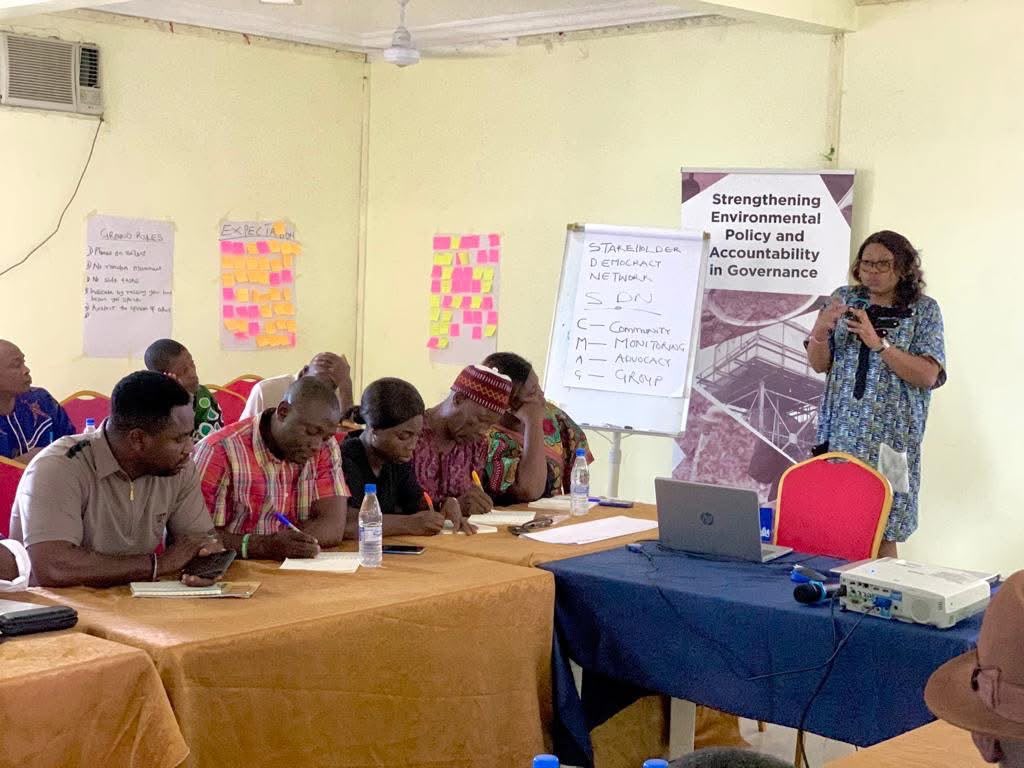
Objective -
To contribute towards ensuring communities in the Niger Delta experience fewer negative effects of the oil and gas industry and greater benefits from the revenues it provides, and that both local and global environmental impact from the oil and gas industry is reduced
Funded by the Ministry for Foreign Affairs of the Kingdom of the Netherlands | 2021–2024 | Delivered with YORDI
Across the Niger Delta, oil wealth and visible development have rarely moved together. Nigeria’s federal government alone earned over $741 billion in oil and gas revenue between 2000 and 2021, with more than $3 billion a year allocated directly back to the region through state governments, federal agencies, and dedicated development bodies. Bayelsa, an oil-producing state, has been a direct recipient of that flow. Yet, as SDN’s own research has repeatedly found, allocated funds have a long history of disappearing into projects that are never finished, duplicated, or quietly embezzled not because the money isn’t there, but because no one outside government has ever had the standing, the documentation, or the organised voice to ask where it went.
For ordinary residents, that failure shows up as a decades-long pattern: roads left half-built, hospitals left half-stocked, streetlights promised and never installed. Budgets were set behind closed doors, with no channel for citizen input and no way for a community to even confirm what had been allocated to them, let alone demand it be delivered. Individual complaints went nowhere, easily dismissed or lost among competing, undocumented requests in Aleibiri; that meant young people leaving the community altogether for lack of a road; in Isampou, it meant children crossing a rotting, termite-damaged bridge to reach school because no one had ever put the danger in writing to the people who could fix it.
SEPAG changed that for 46 communities across six Bayelsa LGAs, by giving ordinary citizens the one thing that turns a complaint into a demand: an organised, documented, unignorable voice.
What changed as a result of the project?
There was a perception shift by community members that they can hold their leader’s accountability and attract development to their communities based on their own development demands. They took ownership and reported on tangible development outcomes
How SDN supported or contributed to the change
SDN provided trainings from a rights-based approach on leadership, advocacy, communication skills. SDN also supported with resources to enable community members engage with their representatives.
The CMAG model has been proven as a sustainable approach to community development and accountability through evidenced reporting, therefore:
Building the voice: In March 2022, SDN and partner YORDI walked into 24 communities and engaged 380 residents face-to-face, securing formal commitments from community leaders and forming 24 Community Monitoring and Advocacy Groups (CMAGs), 288 members in total, 54% of them under 35. Each CMAG was trained in leadership, communication, and advocacy, then helped compile a “Village Book”: a citizen-authored record of exactly what their community needed and who was responsible for delivering it. 1,800 Village Books were produced across the 24 communities. As one participant, Nathaniel, put it after his training: “I am now passionate about serving my community and driving development for my people… this initiative is not about fame or money; it is about genuine community development.”
What that voice achieved, community by community:
- Aleibiri a community young people were leaving for lack of opportunity, got its stalled access road finally completed, plus 223 solar streetlights.
- Isampou replaced a rotting wooden bridge “This bridge will not withstand the next flood,” one resident warned, with repairs now underway toward a permanent concrete crossing.
- Kaiama secured a school fence (ending years of theft and truancy), a community pavilion built after a near-fatal accident exposed the need for one, and over 1,500 solar streetlights installed in two phases.
- Odi got new internal roads and a fully renovated general hospital, with pharmacy and patient wards included, after years of residents relying on chemist shops and herbal practitioners.
- Etieama saw its abandoned ICT centre and school water borehole rehabilitated and reopened by September 2024.
- Igbeta-Ewoama’s community pushed so hard on Facebook and through direct letters that the state’s Deputy Governor personally intervened to restart construction of an abandoned Government Science and Technical College.
- Toru-Orua got a water project completed that had sat abandoned for over a decade, after the community engaged a sitting Senator and former state Governor directly.
- Agudama-Ekpetiama got a collapsed bridge repaired after a CMAG member’s WhatsApp photos reached the State Commissioner of Works, plus a full renovation of its dilapidated secondary school.
- Adaegbabiri, Ogbia Town, Okutukutu, Onopa, and Otuokpoti each secured their own wins: a community pavilion, vigilante equipment and stipends, a reticulated water borehole, 750 solar streetlights, and a new access road under construction.
The scale, in numbers:
- 36 development projects delivered, 50% above the original target of 24, worth a confirmed ₦2,498,390,000 across 15 Bayelsa communities.
- An estimated 45,000 people now have direct access to the roads, clean water, streetlights, and healthcare facilities their communities fought for.
- 287 CMAG members trained in budget analysis across six 3-day workshops in 2023, giving ordinary citizens the technical skills to read and challenge government budgets, not just ask for projects.
- Over 54 direct advocacy engagements with government ministries and officials in 2023–2024 alone, backed by a 24-member State Monitoring and Advocacy Group that pushed policy-level priorities in flood management, healthcare, and transport, beyond individual communities.
- A CMAG-branded radio programme launched with Creek FM, and a social media campaign that reached 4,570,000 impressions over the project’s lifetime.
Beyond individual projects — a shift in how the state does government: the Bayelsa State Ministry of Budget and Economic Planning formally adopted a more inclusive, participatory approach to its annual budget process, directly citing the Village Books as a model, with 24 Village Books officially presented to the Governor of Bayelsa State through his Chief of Staff in October 2023.
Support the replication of the CMAG model in more hard-to-reach Niger Delta communities.
ENABLING CIVIC SPACE IN THE NIGER DELTA (SCALE/PALLADIUM PROJECT)
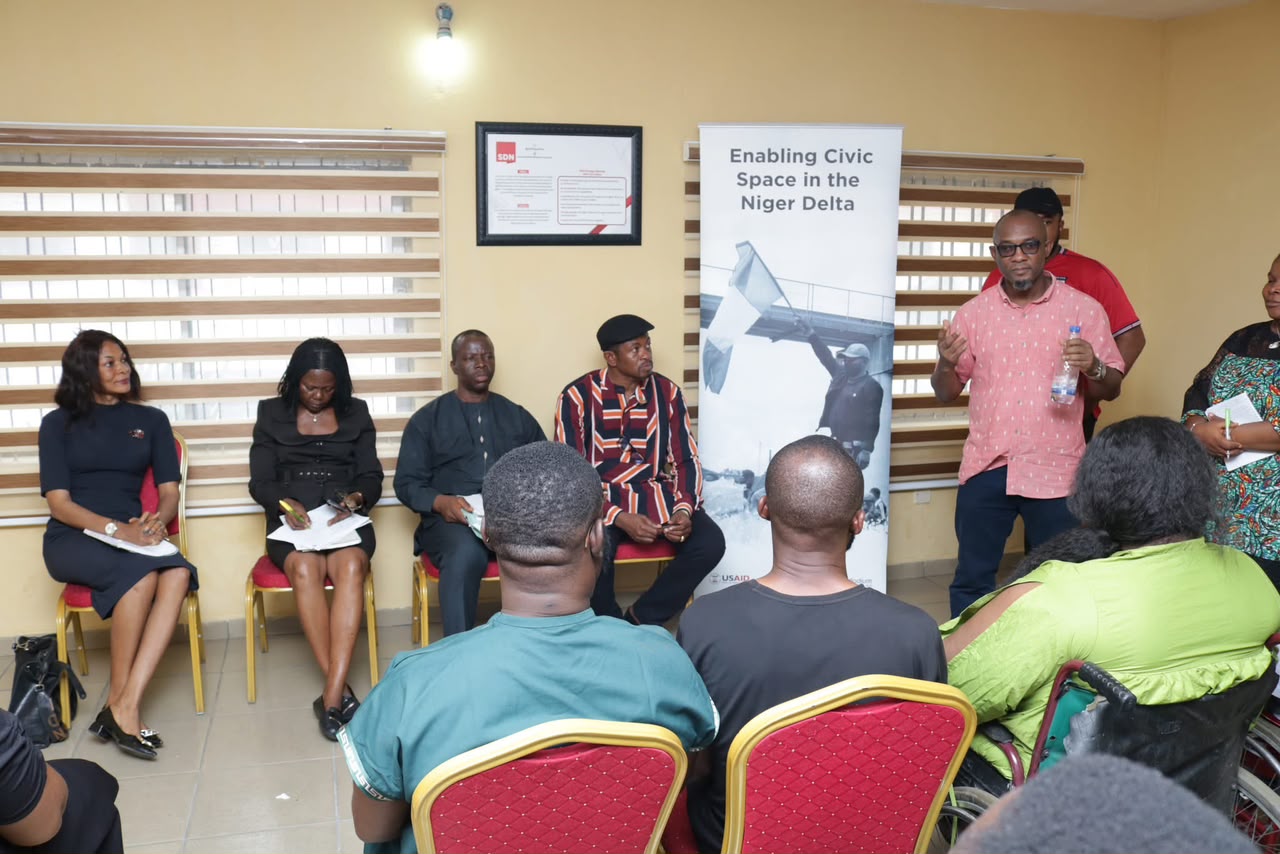
Objective -
To protect civic freedoms through increased collaboration among CSOs and mobilize support for the domestication/implementation of the Administration of the Criminal Justice Act.
Strengthening Access to Justice to Safeguard Civic Space
The establishment of the Administration of Criminal Justice Monitoring Committees in both Bayelsa and Akwa Ibom, and the inception of the Police Duty Solicitor Scheme in Rivers State. The project has also resulted in improved collaboration among stakeholders (civil society actors, government MDAs, PwDs and other actors)
What changed as a result of the project?
The establishment of the Administration of Criminal Justice Monitoring Committees in both Bayelsa and Akwa Ibom, and the inception of the Police Duty Solicitor Scheme in Rivers State. The project has also resulted in improved collaboration among stakeholders (civil society actors, government MDAs, PwDs and other actors)
How SDN supported or contributed to the change
SDN supported with the resources which enabled cluster organisations to mobilise towards the achievement of outcomes mentioned above.
Before: Nigeria’s 2020 #EndSARS protests brought renewed attention to the risks citizens could face when exercising their rights to protest and participate in public life. In Rivers State, as elsewhere, some protesters and other citizens were arrested and detained, including cases where people spent extended periods in custody without timely access to legal representation or a prompt judicial review of their detention. These experiences exposed a wider problem: legal protections can only safeguard citizens when the institutions responsible for enforcing them work effectively.
Nigeria’s Administration of Criminal Justice Law (ACJL) provides safeguards intended to prevent unnecessary and prolonged detention, including requirements around arrest procedures, detention and access to legal assistance. Yet these protections did not always translate into practice. Limited awareness of legal rights, gaps in access to legal representation, weak monitoring of detention and inconsistent application of criminal justice procedures could leave people vulnerable, particularly those without the resources or connections to challenge their detention.
This was not only a justice-sector problem. When people can be detained without effective access to due process, it can discourage citizens from exercising their rights, participating in public debate or challenging decisions by authorities. Strengthening access to justice was therefore also part of creating a civic environment in which people could participate without fear that exercising their rights would leave them without recourse.
Building on earlier work that contributed to the release of nine citizens detained in Port Harcourt following the #EndSARS protests, SDN led a coalition of seven NGOs to address the gap between legal protections and their implementation across Rivers, Bayelsa and Akwa Ibom States. The focus was not simply on responding to individual cases, but on strengthening the mechanisms, knowledge and coordination needed to help citizens understand their rights, access legal support and hold institutions accountable for applying criminal justice safeguards.
After: Turning Criminal Justice Protections into Practice
The project helped move the Administration of Criminal Justice Law from legislation on paper towards mechanisms for monitoring and implementation. In Akwa Ibom, advocacy by the state cluster, supported by the project’s observatory committee, contributed to the Governor signing the Administration of Criminal Justice Bill into law on 16 May 2022, five years after the State House of Assembly passed it in 2017. This achievement closed a significant gap between the law’s passage and its coming into force.
The work also helped establish permanent mechanisms to monitor implementation. Bayelsa State established and inaugurated its Administration of Criminal Justice Monitoring Committee on 14 June 2022, with a civil society representative from the project cluster appointed to the committee. In Akwa Ibom, the State Chief Judge established and inaugurated a 10-member ACJ Monitoring Committee in November 2023, comprising six men and four women, in line with ACJL requirements. These committees provide a formal mechanism to monitor the management of criminal justice institutions and protect the rights and interests of suspects.
In both Bayelsa and Akwa Ibom, the Chief Judges also issued Practice Directions to guide implementation of the ACJL and clarify how the law should operate within the criminal justice system. This added an institutional layer of guidance for applying the protections in the legislation.
In Rivers State, the project contributed to the establishment of the Police Duty Solicitor Scheme in collaboration with the Legal Aid Council. The scheme places legal support at police stations, allowing detained people to access a lawyer earlier in the process rather than waiting until a case reaches court. Five police locations — Old GRA, Mini-Okoro, State CID, Police Headquarters and the Central Police Station — established duty solicitor desks. The scheme is intended to help protect suspects’ rights, including reducing the risk of statements being obtained through coercion or other abusive practices.
Together, these changes strengthened the institutional infrastructure for protecting rights within the criminal justice system across the three states. Akwa Ibom brought its ACJL into force after years of delay; Bayelsa and Akwa Ibom established monitoring committees and issued Practice Directions to support implementation; and Rivers introduced a Police Duty Solicitor Scheme that places legal assistance at the point of arrest. These are significant changes in the systems and mechanisms available to protect due process.
The project was able to document these institutional changes, but it could not establish how many people subsequently benefited from the Police Duty Solicitor Scheme because police stations did not maintain or provide consistent records of its use. This limits what can responsibly be claimed about the scheme’s reach, but not the significance of establishing a mechanism that enables suspects to access legal support earlier in the criminal justice process.
Support continued monitoring of citizens’ rights and access to justice across the Niger Delta.
Implemented through Palladium | Funded by the UK Foreign, Commonwealth & Development Office (FCDO)
DEEPENING ACCOUNTABILITY AND STRENGTHENING INCLUSION (DASI) PROJECT
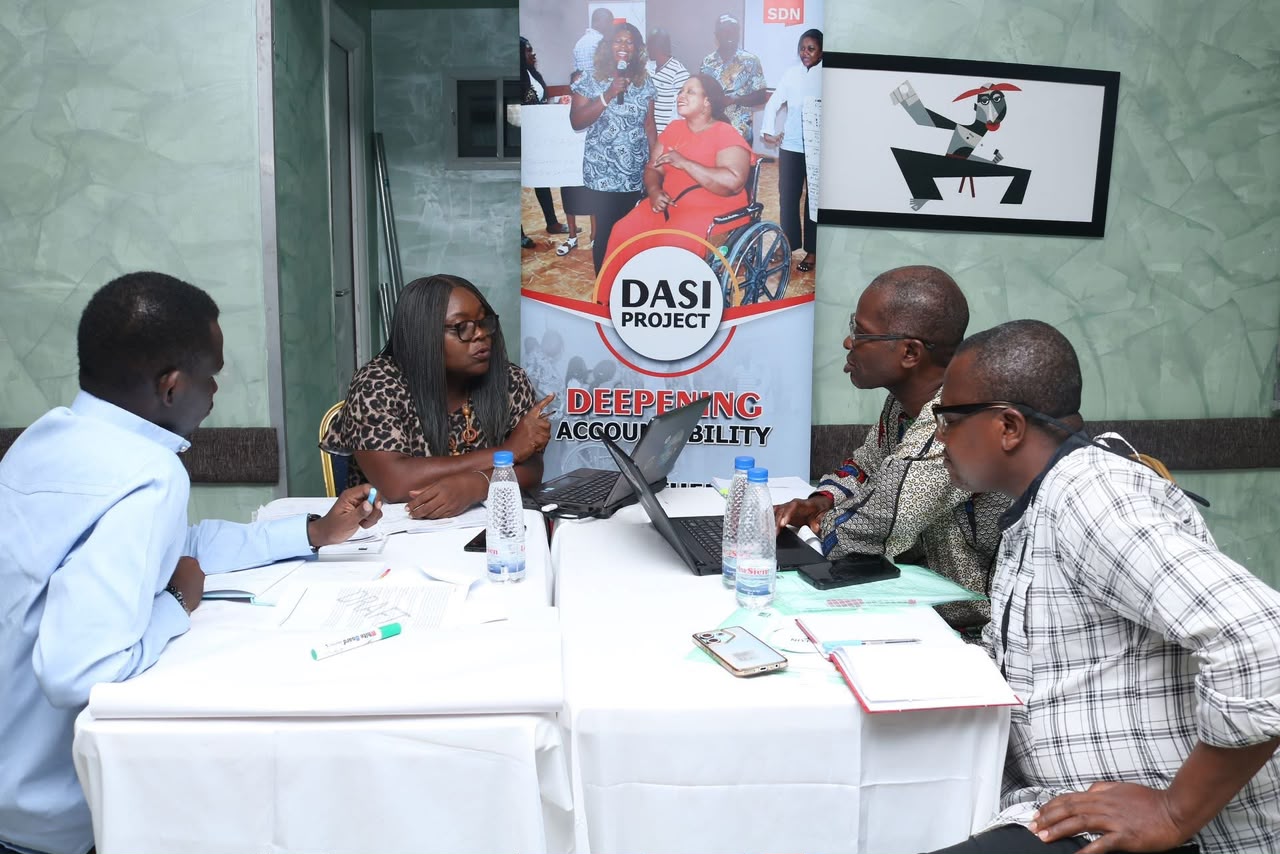
Objective -
To further contribute to accountable, responsive and inclusive governance in the Niger Delta following the 2023 elections by galvanizing public support to push for the policy demands and secure commitments by the state government to follow through on issues that affect women, young persons as well as persons with disabilities within the state (Rivers State).
Turning Election Promises into Policy for Women, Young People and Persons with Disabilities
The DASI project was an extension of the WeYOU Project where SDN worked directly with 48 selected WeYOU Ambassadors and 32 representatives from civil society, along with private sector representatives, to follow-up on electoral commitments made by elected candidates and policy demands contained in the Women and Youth Agenda (WAYA). Specifically, WeYOUAmbassadors and CSO Networks were supported to carry out advocacy engagements with key stakeholders at the state and local government levels. SDN on this project provided technical support via direct engagements with the Rivers state government on policy priorities.
What changed as a result of the project?
The first ever Rivers State Youth Policy was launched and is being implemented by the Rivers State Ministry of Youth Development. The existing Rivers State Persons with Disabilities Welfare (Enhancement) 2011 was repealed and replaced with a validated draft bill (Rivers State Discrimination Against Persons with Disabilities, 2024) and is currently with the Office of the Public Defender, Rivers State Ministry of Justice pending when the political situation with the State House of Assembly is resolved.
How SDN supported or contributed to the change
SDN provided technical support on the development of these policies and bill and also mobilized civil society organisations, Persons with Disabilities (PwDs) clusters and citizens to push demands to the fore via campaigns and advocacy engagements.
Before: Women, young people, and persons with disabilities in Rivers State have long faced underrepresentation in political decision-making, and this has led to policies and public resources that do not reflect their priorities. The issue extends beyond electoral participation; these groups lack sufficient mechanisms to unite around shared goals, present specific demands to political candidates, and engage elected officials after elections to hold them accountable for their commitments. Recognising this critical gap, SDN’s previous work sought to strengthen the link between grassroots concerns and state-level decision-making.
The We-YOU project, supported by the FCDO, mobilised 12 communities in Rivers State, empowering women and young people with the skills needed for campaigning, policy advocacy, and influence. Through extensive consultations, we developed a shared Women and Youth Agenda (WAYA) for the 2023 elections, articulating vital policy demands. These include increasing women’s representation in elected and appointed positions, establishing a Rivers State Gender Policy, thoroughly reviewing and amending the Rivers State Disability Welfare Enhancement Law, and developing a comprehensive state Youth Policy.
The real challenge after the 2023 elections was ensuring these demands did not fade into another set of unfulfilled campaign promises. The DASI initiative aimed to sustain momentum beyond the elections by extending the We-YOU network and empowering citizens and civil society to engage elected officials and government institutions on critical policy issues they promised to address.
After: The DASI project mobilised 48 We-YOU Ambassadors and 32 civil society representatives to follow up on the commitments made by elected candidates and the priorities outlined in the Women and Youth Agenda. This initiative extended beyond the election period, establishing a structured basis for ongoing engagement with the government on policies and reforms affecting women, young people, and persons with disabilities. The advocacy efforts contributed to the development of Rivers State’s first-ever Gender Policy, which creates a state-level framework for addressing gender inequality and enhancing women’s participation in governance and development. The policy is now being used by the Rivers State Government to guide its work on gender inclusion, turning it from an election commitment into a core element of the state’s policy framework.
Additionally, the project helped formulate the Rivers State Youth Development Policy, which addresses young people’s priorities, such as governance participation, employment, and entrepreneurship. The Rivers State Government also uses this policy to guide its programs and engagements with young people.
For persons with disabilities, advocacy efforts led to the preparation of the Rivers State Discrimination Against Persons with Disabilities Bill, 2024. This bill is designed to replace the outdated 2011 Rivers State Persons with Disabilities Welfare (Enhancement) Law. The validated bill provides an updated legislative framework to combat discrimination and enhance the inclusion and protection of persons with disabilities. It is currently awaiting passage.
Together, these changes demonstrate how the priorities identified by women, young people, and persons with disabilities have been integrated from community consultations and the Women and Youth Agenda into state-level policy and legislative processes. The development and implementation of the state’s first Gender Policy and Youth Development Policy, along with progress toward updated disability legislation, illustrate a shift from merely identifying the needs of marginalised groups to embedding those priorities within the systems through which the government plans and executes its work.
Help fund continued advocacy for inclusive and accountable governance in Rivers State.
Funded by the UK Foreign, Commonwealth & Development Office (FCDO)
SDN research across 5 states of the Niger Delta conducted in 2019 revealed a decline over the preceding two decades in women’s representation in politics and leadership positions.
COMPLETED
The Deepening Accountability and Strengthening Inclusion (DASI) project builds and expands on previous work by SDN to increase political participation...
COMPLETED
This two-year project aims to protect basic civil liberties in Akwa-Ibom, Bayelsa and Rivers States and to mobilize support for the domestication/mobilization of the Criminal Justice Act.
COMPLETED
We-YOU-Project is a 19-month project in partnership with ActionAid Nigeria with funding from the UK Foreign, Commonwealth and Development Office (FCDO).
COMPLETED
This six-month project aims to expand collective action by civil society in Rivers State to challenge threats, and create opportunities, to widen civic space.
COMPLETED
This project seeks to improve the relationships between electricity distribution companies (DisCos), consumers, and other key stakeholders by building awareness, communication, and trust between them.
COMPLETED
This project aims to support the Ministry of Niger Delta Affairs (MNDA) to ensure the effective coordination and monitoring of development initiatives in the Niger Delta.
COMPLETED
This project aims to increase communication between civil society organisations (CSOs) and individuals, and the Niger Delta Development Commission’s (NDDC) to improve transparency and accountability in infrastructure projects to develop the Niger Delta.
COMPLETED
This project is seeking to improve the credibility, fairness, and freedom of state-level elections in Bayelsa, funded by the United Nations Democracy Fund (UNDEF) for the period of 18 months in Bayelsa State.
COMPLETED
Niger Delta Watch 2019 is a citizen-led elections observation project reporting on the 2019 Nigerian presidential and governorship elections.
COMPLETED


